
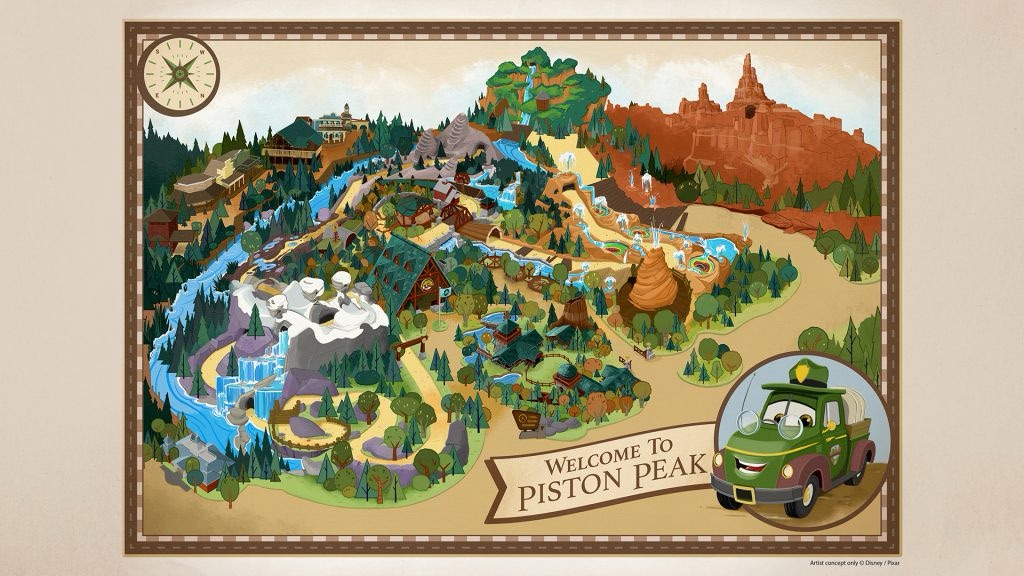
In August 2024, Disney announced that a new Cars-themed land would be coming to Magic Kingdom. It would replace both Rivers of America and Tom Sawyer Island, two original fixtures of Frontierland.
From the start, fan reactions were mixed (is anyone surprised?). Some fans were excited. Others, to put it mildly, had concerns about the new development. Would the Cars ride break sightlines? Were water features being removed entirely? Would the land become another hot, open hardscape? And did the Cars franchise even make sense in the context of Frontierland? These Cars Land Magic Kingdom fan concerns have sparked lively discussions among enthusiasts.
Nearly a year later, with closures of Rivers of America and Tom Sawyer Island set for July 2025, Disney released an update through the Disney Parks Blog announcing Piston Peak as the setting for this new land.
The Disney Parks Blog post served two purposes. One was promotional, offering new story context and concept art for those excited about the project. But maybe more importantly, it was deliberately structured to address the long-running concerns from fans who still had questions.
Without calling out any criticism directly, the post walks through the most commonly discussed issues. It reads less like marketing copy and more like a subtle reassurance that imagineering understands the assignment.
What follows is a list of 4 major fan concerns and how Disney’s latest Piston Peak update directly addressed them.
1. “Will I See Cars Racing from Liberty Square?”
What fans were worried about:
That guests in nearby areas like Liberty Square would be able to see or hear the Cars attraction, especially high-speed racing elements, breaking the illusion that each land is a separate world.
What Disney said:
“From the outside, trees will provide a natural barrier between the off-road rally and other parts of Frontierland and Liberty Square. Rugged mountains with dramatic peaks will be nestled along a calming waterway across from Grizzly Hall…”
In this section Disney directly references both the surrounding areas and the new attraction. They specifically name Liberty Square and Frontierland, and describe multiple layers of natural buffers. Trees, mountains, and water are designed to block views and noise from the outside.
The message is clear. The rally-style ride is meant to stay visually and thematically self-contained.
2. “Is Disney Really Getting Rid of the River?”
What fans were worried about:
That removing Rivers of America would mean not just losing a major visual anchor, but eliminating one of Magic Kingdom’s elements: flowing water. The slow-moving river and riverboat didn’t just fill space; they added motion, reflection, quiet, and a cooling presence. Without them, many feared this section of Frontierland would feel less alive and lose the atmosphere that made it distinct.
What Disney said:
“Imagine an awe-inspiring wilderness filled … scenic vistas, trails, and natural features like flowing rivers and cascading falls… all designed in harmony with the surrounding landscape.”
“Rugged mountains with dramatic peaks will be nestled along a calming waterway across from Grizzly Hall…”
Disney is emphasizing water as a defining element of the new land, and the language in the post goes out of its way to make that clear.
Phrases like “flowing rivers,” “cascading falls,” and especially “calming waterway” signal that water will remain central to the land’s look and feel. The language is clearly meant to reassure fans that the tranquil, natural atmosphere they were worried about isn’t going anywhere.
3. “Pave Paradise, Put Up a Parking Lot?”
What fans were worried about:
Some fans were worried this would be another wide-open space with lots of pavement and not much shade, basically, hot. A few even echoed Joni Mitchell’s 1970s classic that Disney was “paving paradise, to put up a parking lot” voicing their concerns about trading trees and water for concrete.
What Disney said:
“To make sure these buildings fit naturally within the surrounding majestic landscapes, Imagineers are using a style of architecture called “Parkitecture,” which was developed by the National Park Service to create structures that harmonize with the natural environment.”
This part of the blog reads like a direct counter to that narrative. They imply that tree cover and terrain are central to the land’s layout. The term “parkitecture,” borrowed from real-world National Park design, points to the use of stone, wood, and vertical layers. The language reinforces the idea that the land is being designed for comfort, texture, and immersion, not concrete sprawl.
4. “Does Cars Even Belong in Frontierland?”
What fans were worried about:
That the Cars franchise, with its modern aesthetic and brash characters, doesn’t match the historical frontier theme of the surrounding land.
What Disney said:
“Guests have traveled from Liberty Square… to Big Thunder Mountain… all led by heroic characters… Piston Peak National Park continues this tradition of American storytelling.”
Instead of fitting Cars into the old West, Disney reframes Frontierland itself. By leaning into the National Parks narrative, first introduced in Planes: Fire & Rescue, the expansion pushes Frontierland into the early 20th century. It’s still grounded in American landscape storytelling, just from a different point in time.
And let’s be honest Frontier Land hasn’t really been fully cohesive since Splash Mountain was built back in the 80s.
Final Thoughts
The Piston Peak National Park blog post was not a routine update. It was a dual-purpose message, meant to promote a major expansion and to reassure fans who had been raising concerns since D23.
With the closures of Rivers of America and Tom Sawyer Island just weeks away, the timing makes it clear. This was Disney’s last word before work begins, a final round of calm reassurances. It was a structured response to the concerns that have followed this project for nearly a year.
It didn’t engage in debate or call attention to criticism, but its message was clear in how it was written. Fans concerns were heard, and Imagineering clearly has a handle on them.